
Showing posts with label EPA. Show all posts

Monday, July 2, 2018

Climate Change Debate Takes New Turn As Questions Arise Over EPA Secret Science

Climate Change Debate Takes New Turn As Questions Arise Over EPA Secret ScienceBrandon Turbeville
Natural Blaze
June 20, 2018

The political theatre between climate change fanaticism and free market lack of regard for the environment is continuing apace and notably so with a recent move by the EPA Science Advisory Board.

The SAB voted on May 31 to review a series of rules that the EPA under administrator Scott Pruitt, proposed over the past eight months.

These new rules include a plan to limit the use of “secret science” as well as proposals to strike down limits imposed on greenhouse gas emissions.

The former rule change would prevent the EPA from relying on scientific studies that include “non-public data” in formulating its policy. Pruitt is framing the new decision to be based on transparency.

On May 12, the SAB criticized the EPA for not submitting the new rule to the SAB for review. As Nature reports, “The working group is very much in favor of transparency,” said Alison Cullen, an environmental health researcher at the University of Washington in Seattle and chair of the working group, during the SAB meeting. But on this particular proposal, there is a “very real lack of clarity” in how the rule would be applied," she said.

A number of scientists and environmentalists argue that the new EPA rule is counterproductive simply because it limits the agency in what data it can use. They argue that some of the data cannot be made public due to privacy concerns.

Both sides clearly have a point. If the EPA has non-public information pointing toward a certain chemical being toxic, for instance, the EPA should be able to formulate a policy based on the real scientific evidence.

Monday, April 2, 2018

EPA Relaxed Dicamba Regulations Following Monsanto Research, Records Show

EPA Softened Dicamba Regulations Following Monsanto Research, Records ShowBrandon Turbeville
Natural Blaze
March 28, 2018

In case anyone might be surprised to learn that the EPA eased regulations on the toxic and volatile herbicide Dicamba after receiving industry research from Monsanto, reports are surfacing that the government agency did just that. Indeed, the agency weakened protections the agency itself set for crops and wildlife habitats after Monsanto presented its own research that showed lower estimates of how far the chemical can drift.

In short, the research that Monsanto provided to the EPA and that the EPA based its revised decisions upon is in conflict with research that was conducted by independent researchers and organizations. No surprise there.

As Johnathan Hettinger writes for Sustainable Pulse and Investigate Midwest,

“The EPA expects that exposure will remain confined to the dicamba (DGA) treated field,” the agency wrote in the final registration approving the use of dicamba in November 2016.

However, drift from dicamba damaged more than 3.6 million acres of soybeans in 2017, according to data from Kevin Bradley, a professor at the University of Missouri.

The drift also allegedly damaged oak trees, wildlife habitats, and other crops, such as vineyards, across the Midwest and South, according to news reports, environmental groups, and complaints filed with state agencies.

Monsanto submitted its research after the U.S. EPA proposed in March 2016 an all-directional buffer zone for dicamba to help protect other crops and wildlife habitats for endangered species. After considering the information, the agency decided to reduce the buffer zone to only a downwind buffer zone, meaning spraying limitations only applied to the downwind edge of a field.


Monday, August 15, 2016

Atrazine: EPA Report Confirms Common Herbicide Dangers To Environment, Animals

atrazineBrandon Turbeville
August 15, 2016

EPA atrazine Report Confirms Dangers To Environment, Animals; Doesn’t Address Side Effects To Humans

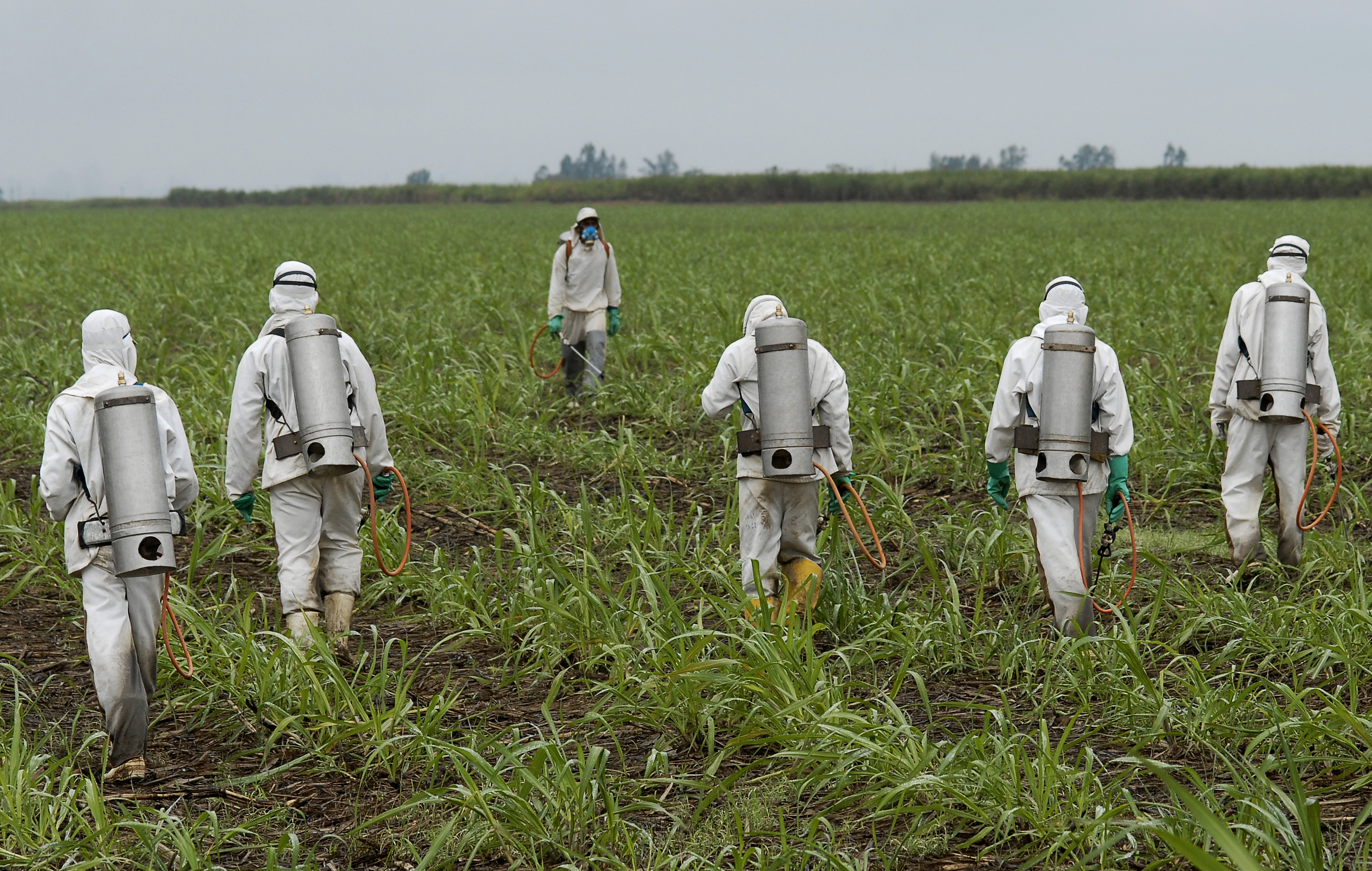
While much attention is placed on the toxic herbicide glyphosate, a recent 500-page draft report released by the EPA reveals just how toxic of a landscape the American agricultural system is.

As part of their requirement to review pesticides and herbicides being used in the United States every 15 years, the EPA recently updated their Environmental Impact Assessment for Atrazine. after glyphosate, atrazine is the 2nd most widely used herbicide in the country. A chlorine-based chemical, atrazine can persist in the soil for 22 years and an estimated 70 million pounds is sprayed on crops every year.

The EPA’s report confirms that atrazine, produced by multinational Big Ag companySyngenta, is harmful to animals including fish, and that it leaves behind a rather alarming amount of residue. According to the EPA’s report, atrazine is 62 times higher than what the agency considers a concern for risks to fish. Atrazine exceeds the levels of concern for chronic risks to animals by 198 times.

This report confirms the research of Dr. Tyrone Hayes who claimed that the herbicide was chemically castrating male frogs. Hayes worked for Novartis – a company that is now owned by Syngenta – at the time of his research which, unsurprisingly, Novartis refused to publish.

Hayes resigned, obtained independent funding for his research, which he then subsequently published. As a result, he was subjected to a smear campaign by Syngenta. Although atrazine doesn’t typically kill animals directly, it clearly affects their reproductive, hormonal and developmental systems. Indeed, the EPA’s report admits that adverse effects can occur at relatively low levels and even in lower levels than what were previously known.